AI projects rarely fail because the model is "not smart enough." They fail because the total cost is misunderstood.
Most effort goes into the system around the model: data readiness, integrations, governance, and adoption.
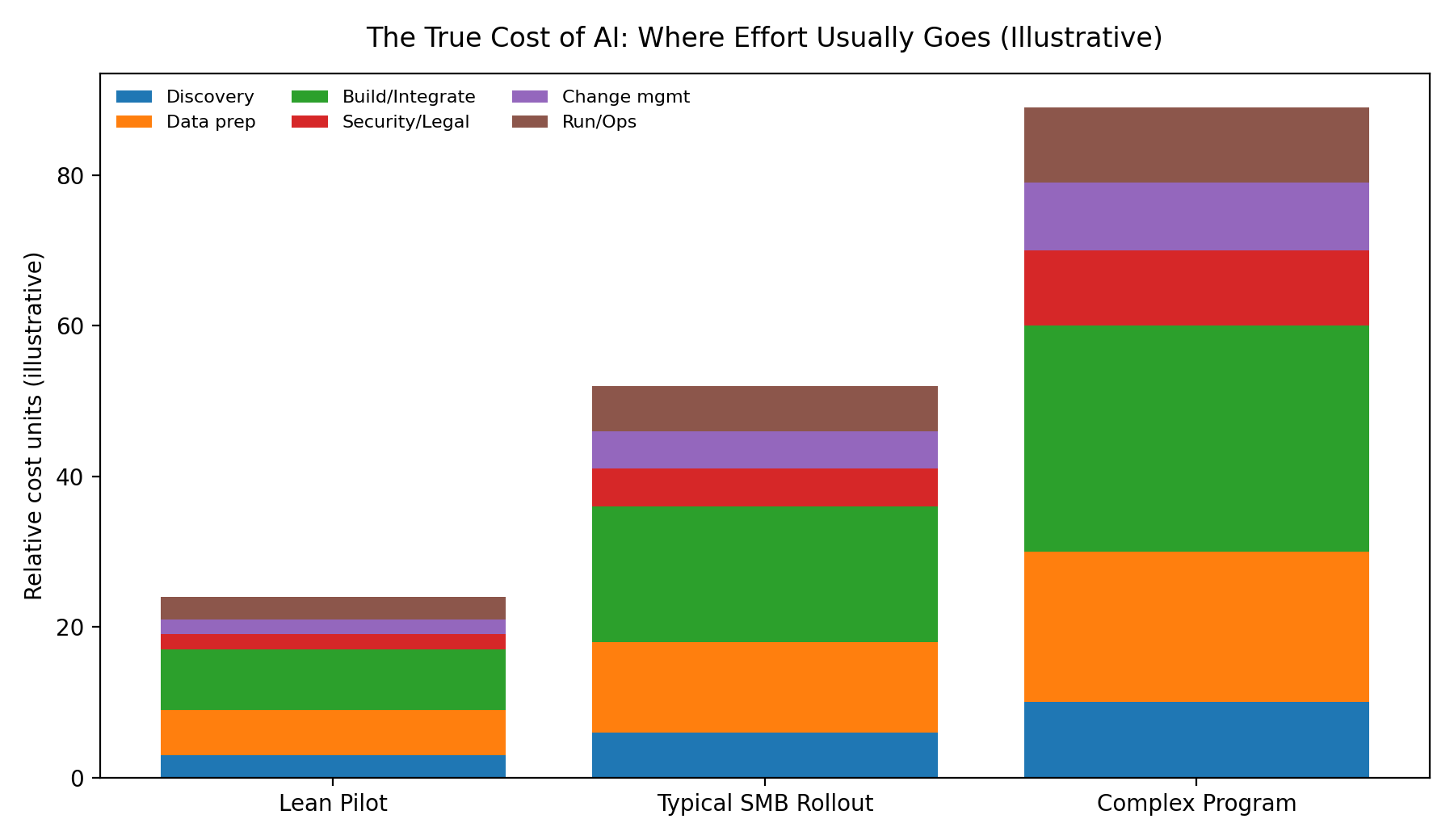
The 6 Cost Buckets
When budgeting for AI implementation, plan for these six areas:
1. Discovery & Scoping
Understanding the problem, mapping workflows, defining success metrics. Often 5-10% of total investment.2. Data Preparation
Cleaning, structuring, and validating your data. Frequently the largest hidden cost—20-40% of budget.3. Build & Integration
Connecting AI to your existing systems: CRM, ERP, helpdesk, databases. Custom integrations add complexity.4. Security/Legal/Governance
Compliance reviews, data privacy, access controls, audit trails. Non-negotiable for enterprise deployments.5. Change Management & Training
Getting your team to actually use the system. Training, SOPs, feedback loops. Often underestimated.6. Ongoing Operations ("Run")
Monitoring, tuning, updates, support. Budget 15-25% of initial investment annually.A Simple ROI Method
Net Monthly Value = (Time Saved × Fully Loaded Cost) + Revenue Lift − Run Costs Break-even month = Initial Investment ÷ Net Monthly Value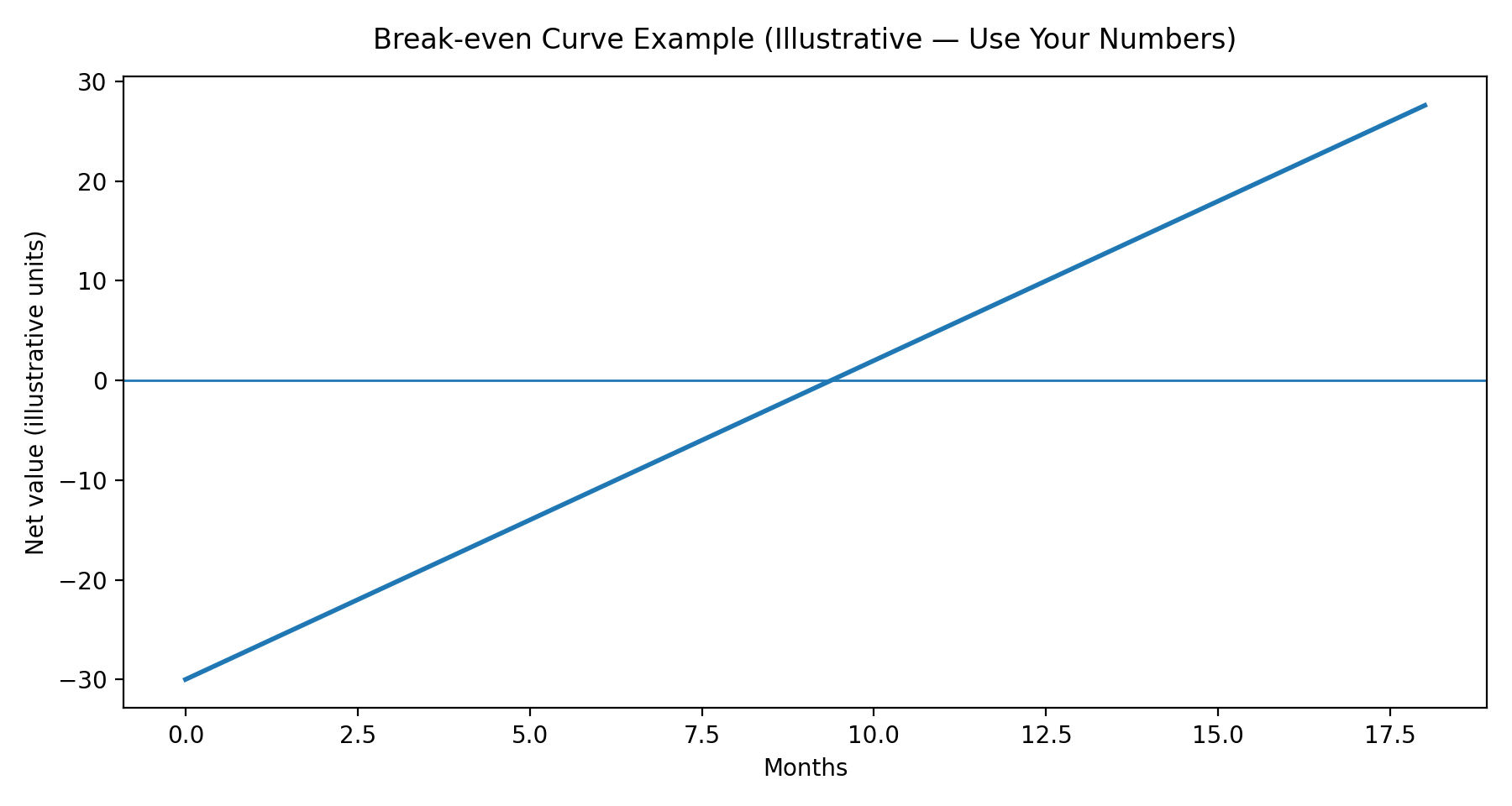
Example Calculation
- Time saved: 20 hours/week
- Fully loaded cost: $40/hour
- Monthly savings: 20 × $40 × 4.3 = $3,440
- Run costs: $500/month
- Net monthly value: $2,940
- Initial investment: $15,000
- Break-even: ~5 months
Avoid "ROI Fantasy Math"
Common mistakes that inflate projections:
- Being optimistic about adoption rates. Assume 60% utilization in month one, not 100%.
- Ignoring ramp-up time. The first 30-60 days are learning, not full production.
- Skipping human-in-the-loop. Design oversight early—it catches errors and builds trust.
- Comparing against zero. Your baseline is the current process, not nothing.
Operations consulting matters because the biggest wins come from removing friction and tightening execution—not "AI features."
Common Questions
Why do AI projects cost more than expected?
Data work, integration, governance, and adoption drive most of the effort—not the AI model itself.How do we estimate ROI if benefits are indirect?
Start with measurable time saved and error reduction on one workflow. Expand from there.What's the best first project?
A high-volume, repeatable workflow with clear metrics. Ticket triage, document intake, lead routing.Want a realistic ROI model and pilot plan? Book a consultation with Hikm Systems.